|
Southern Taiwan University of Science & Technology worked together with Allianz
Biotech Co., Ltd. in developing new medicine for Alzheimer.
Southern Taiwan University of Science and Technology and Allianz Biotech Co., Ltd. announced on May 31 their jointly development of treatments for Alzheimer in an official press conference. As industry-university cooperation, the project was named "New Medicine Development for Alzheimer." The research results will be shared by both parties of their agreement.
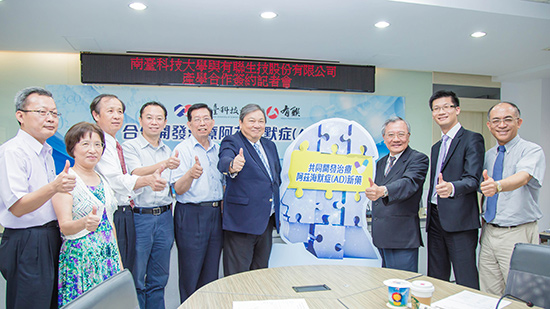
【Southern Taiwan University of Science & Technology worked together with Allianz Biotech Co., Ltd. in developing new medicine for Alzheimer: Executes from Southern Taiwan University of Science & Technology and Allianz Biotech Co., Ltd.】
Allianz Biotech Co., Ltd. will offer US patented syntheses and compounds to Prof. Yi-Jen Su of the Department of Biotechnology, Southern Taiwan University of Science and Technology, while Prof. Su will perform screening six biomarker groups associated with AD. The two types of patented compound selected will be used to develop medicines for the treatment of Alzheimer.
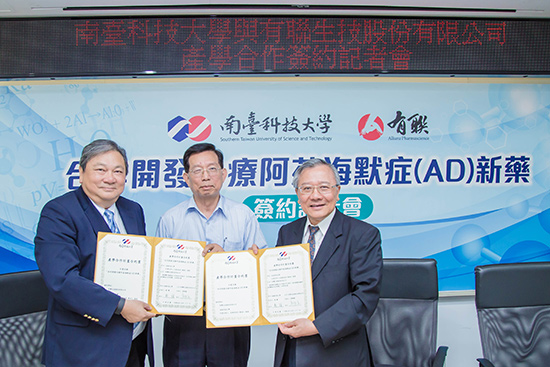
【Southern Taiwan University of Science & Technology worked together with Allianz Biotech Co., Ltd. in developing new medicine for Alzheimer: the press conference for the signing of their industry-university cooperation (from left to right: General Manager Wei-Kang Jan of Allianz Biotech, Prof. Yi-Jen Su of the Department of Biotechnology, and President Tai of Southern Taiwan University of Science and Technology).】
Alzheimer's is a disease that causes dementia, or loss of brain function. It affects the parts of the brain that are important for memory, thought, and language. The brain of a person with Alzheimer's contains abnormal clumps of cellular debris and protein (plaques) and collapsed microtubules (support structures inside the cell). Microtubule collapse is caused by a malfunctioning protein called tau, which normally stabilizes the microtubules. In Alzheimer's patients, tau proteins instead cluster together to form disabling plaques and tangles. These plaques and tangles damage the healthy cells around them, leading to cell death. The brain also produces smaller amounts of neurotransmitters (acetylcholine, serotonin, and norepinephrine), chemicals that allow nerve cells to talk to one another.
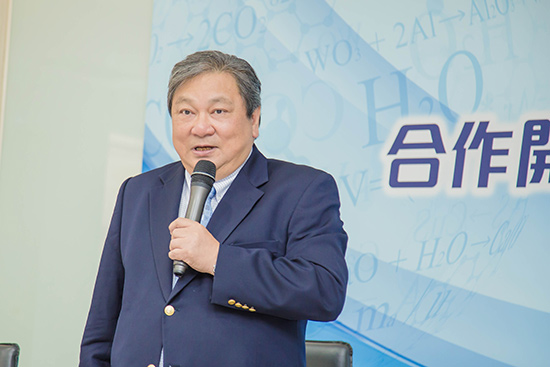
【General Manager Wei-Kang Jan of Allianz Biotech was having a speech in the press conference.】
President Tai said that the cooperation aims at prevention and technological achievements through animal experiments to treat Alzheimer's disease. It will be able to obtain technology licensing for manufacturers to be ready to develop new drugs and other related human experimentation stage for the benefit of patients worldwide. At the same time, Prof. Su, the once anti-SARS hero and the former head of the National Department of Health Disease Control, who is specialized in biology and medicine professional, vowed to assist STUST in developing biotechnology-based health products and in elevating its biotech pharmaceutical technical level.
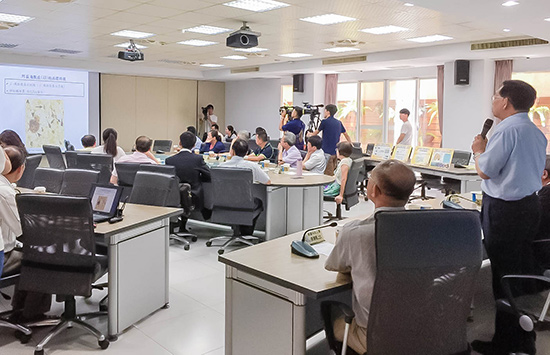
【Prof. Yi-Jen Su of the Department of Biotechnology clarified the content and focus of bilateral cooperation】
Prof. Yi-Jen Su said that this patent pathogenesis of AD is by far the most promising small molecule compounds. The compounds can inhibit β-amyloid precursor and regulate cholesterol metabolism; they comes with anti-oxidation, anti-inflammatory and other properties. Allianz Biotech will share 50% of the funding for animal experiments, which will be implemented jointly by Prof. Kun-Che Hsai form the Institute of Clinical Medicine, Cheng Kung University. The overall assessment will be completed in the period from the end of 2016 to the beginning of 2017.
|