|
According to a recently announced list of approved universities that have received the grant of Industrial Innovation Research and Development Program from the Ministry of Education. There were 46 cases from 26 universities, of which only 7 cases form private universities were approved and Southern Taiwan University of Science and Technology was the only private university of science and technology. The main purpose of the project is to effectively build a linkage between university research and development with industrial resources, establish long-term cooperation between universities and industries, cultivate doctoral-level talents in innovative research and development, and carry its innovative R&D service team forward and set up related departments with industries in cooperation. All these have created a wave of R&D service companies to jointly create industrial value and achieve a win-win situation for both universities and industries.
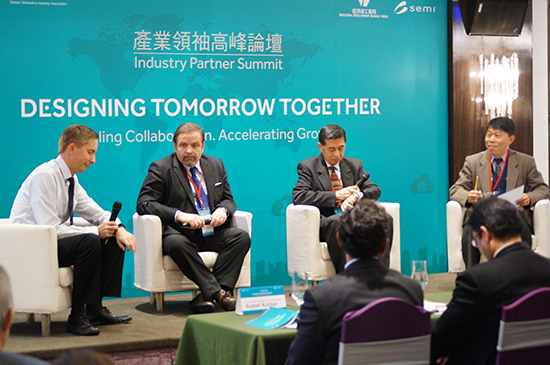
【Jing-Zhou Tang (first from right), Chairman of Automotive Electronics Research Center, Southern Taiwan University of Science and Technology, was invited to the summit talk in the 2016 Automotive Network Industry Leadership Summit.】
Southern Taiwan University of Science and Technology is highly regarded by the judges for its project “AI Technology in the Application of Vehicle Information.” The judges pointed out that the executive team has been cultivated in vehicle information for many years and has accumulated considerable practical experience and knowledge. All these are helpful to partner companies in establishing a new business or a startup.
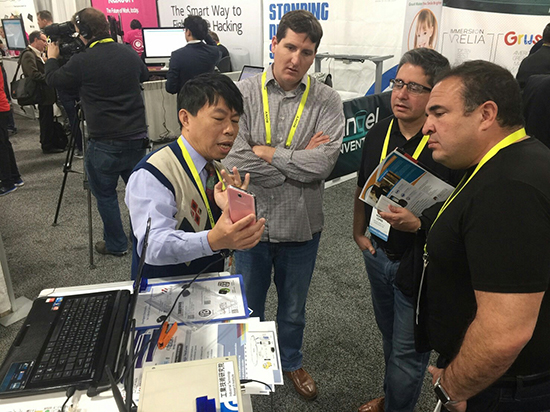
【Jing-Zhou Tang (first from right), Chairman of Automotive Electronics Research Center, Southern Taiwan University of Science and Technology, participated in the 2017 CES Exhibition in Las Vegas, USA.】
In August, 2015, Southern Taiwan University of Science and Technology established Automotive Electronics Research Center, which is a cross-disciplinary research team composed of teachers related to electronics, information engineering, and mechanic engineering. It is the first lab built to work on domestic and international network for the interior of a car. Since its inception, the center has been responsible for a number of cooperation projects with the Ministry of Science and Technology, the Ministry of Education, the Ministry of Economic Affairs, the Legal Personnel (ITRI), and a number of manufacturers of automotive electronics. Starting in November 2017, the first experimental environment for the Internet of Vehicles and Vehicles Security has been built.
The center is based on core technology of Controller Area Network (CAN Bus) and On Board Diagnosis (ODDII), with the aim to assist partner manufacturers in technological breakthroughs in the hardware related products of "vehicle infotainment system." The target of this new proposal is to continue the technological development of the past, to incorporate the sensing data elements of Advanced Driver Assistance Systems (ADAS), and to develop all the elements required for the heterogeneous information fusion—diagnosis, interpretation, storage, communication, communication, information security, and analytical technology. With all these efforts, the center is ready to create a new industry service chain of "driving behavior analysis" and enhance the value-added range of automotive products.
Jing-Zhou Tang, Director of the Automotive Electronics Research Center, Southern Taiwan University of Science and Technology, said that the goal of this innovative R&D program is to assist Megawin Electronics in developing a microcontroller unit (MCU) with a CAN bus interface for vehicles. The application would help the company's existing 8051 MCU upgrade to a higher-end ARM MCU; with its CAN Bus interface, the program attempts to break into the automotive electronics market. In addition, Block Chain will be introduced to confirm the collected data of driving behavior and in-vehicle ECU through the decentralization, openness, independence, security, and anonymity of the technology. The correctness and consistency of subsequent analysis can thus be ensured. Finally, dangerous driving can be identified through Driver Behavior Analysis based on artificial intelligence (such as running through red light and improper overtaking). In the future, it can be used in driver group management and driver insurance pricing.
|