|
The Shennong Street Area, developed by the USR Program team of "Creation and Dissemination of Cultural Elements—Fucheng v.s. Yuejin" from Southern Taiwan University of Science and Technology, was particularly introduced by the Thai tourism program TA DAI MA in April last year (2019). In June 2019, the Japanese "PEN" magazine even used Yaowang Temple at Shennong Street as its cover. This not only increased Shennong Street's international exposure, but also attracted many foreigners in 2019. It introduced the current situation of Shennong Street on Youtube.
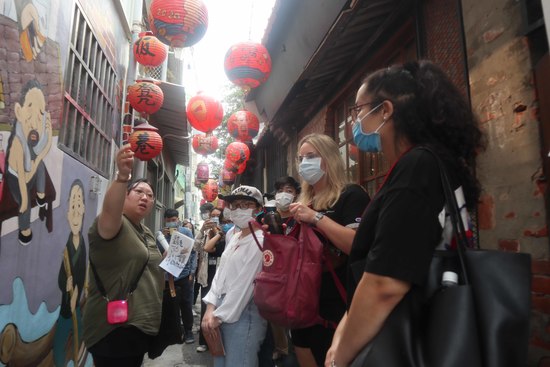
[Tsai-Chin Zheng (left), Chief Executive of Tainan Cultural Association, was telling people the story of the past transporting business at the Beishi Port ruins.]
As Shennong Street gradually opened up its international visibility, it drew the attention of the project team, which came to examine the international environment of Shennong Street and then cooperated with the International and Cross-Strait Affairs Office, Southern Taiwan University of Science and Technology. Together they launched the "A Dialogue between Fate and Far—Shennong Street International Intercourse” series of activities, with an "English Tour to Shennong Street" as the first one. The team developed an internationalized tour to Shennong Street for international exchange students to go through the surrounding Shennong Street.
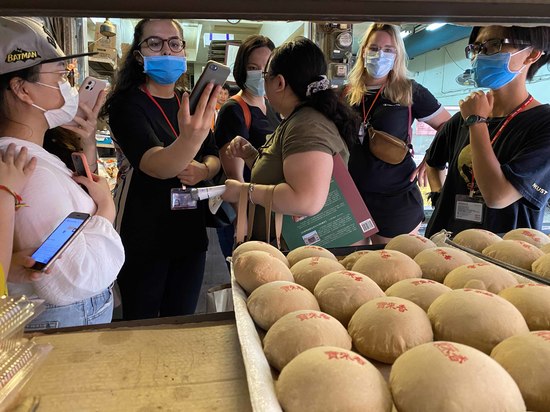
[The project team of Southern Taiwan University of Science and Technology was taking international students to learn about the traditional delicacies of "Pong Cake."]
The international exchange students participating in the event came from four countries, including France, Poland, Indonesia, and Vietnam. They were guided by Chief Executive of Tainan City Cultural Association, Tsai-Chin Zheng, in English. The main purpose was to help students understand the special port street and suburban business culture around Shennong Street, by incorporate traditional local crafts and selecting scenic spots, such as Jinhua Hall, SifoKuo Budda Statue Maker, Beishigang Ruins, Narcissus Palace Temple, Polaishan Bakery, Duma Green Tea, Fucheng Wooden Clogs. All these helped make international students better understand the local culture.
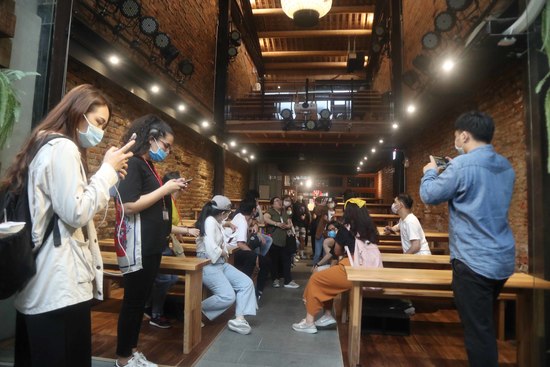
[The project team of Southern Taiwan University of Science and Technology and international students were staying in the theater space of the Ten-Drum Teahouse, looking back to the dining culture of Gonghou Street in the Ching Dynasty.]
This international tour to Shennong Street started from a visit to Five-Channel Port passing through time and space and entering the suburban era of Shennong Street back in the Ching Dynasty. At that time, Shennong Street saw a huge number of dock workers with the surname Hsu; the assembly hall on the street representing these workers was Jinhua Hall. Next to the hall was SifoKuo Budda Statue Maker, an important family of Buddha Art in its fifth generation in Taiwan, also the main engraver the idols of Jinhua Hall. The fire escape alley on the south side of Shennong Street is the remains of Beishi Port. In the old times, Beishi Port flowed eastward to the Narcissus Palace Temple, which oversaw the three suburban areas. Hidden in the market, the Narcissus Palace Temple embraced a number of ships transporting cargoes and medicinal materials through the Beishi Port. During the Ching Dynasty, many ships parked in front of the temple; green tea shops gathered there for dock workers to buy tea, and pastry shops gathered there to meet people’s demand for sacrifices and livelihood needs.
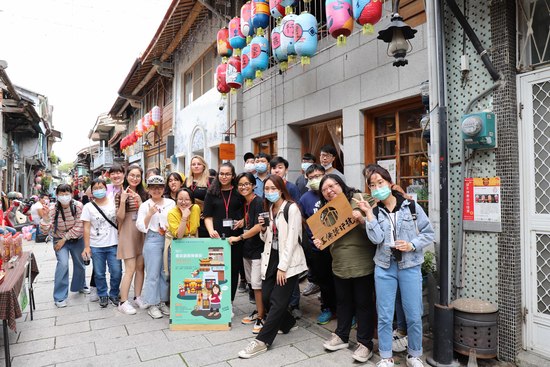
[The project team of Southern Taiwan University of Science and Technology and international students took a group photo in front of the Five-Channel Port Cultural Center.]
In addition to the above-mentioned historical trajectory, international students were not only surprised by the “pongcake” of Polaishan Bakery and the great variety of herbs in Duma Grass Teashop, they were also attracted to Ten-Drum Teashop behind the Narcissus Palace Temple above the only passage to the West Gate and the old Tainan City (Fucheng), as well as the storytelling culture of the former Zuixianlou restaurant in the form of a theater. Every student showed an admiring expression to Shanshing Street, which leads to the wood business of Fotou Port, next to Narcissus Palace Temple. They were also deeply impressed by the experience of wearing clogs at the Fucheng clog shop.
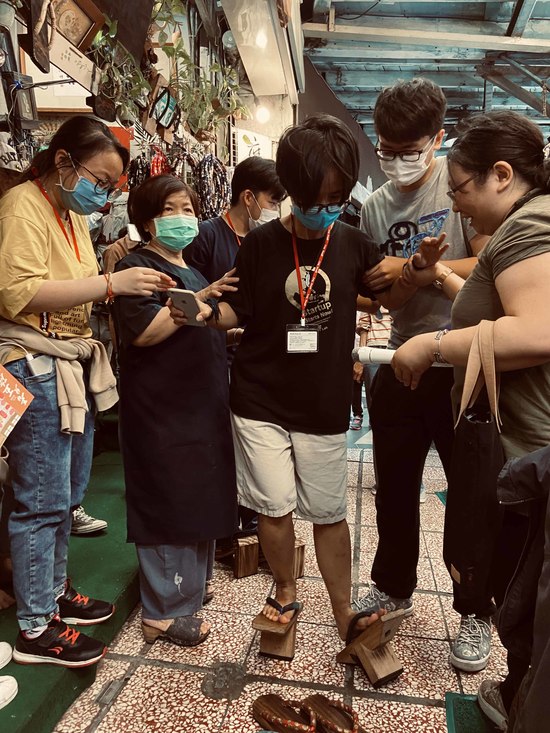
[All the students were learning to recognize the wood business of Shanshing Street next to Narcissus Palace Temple through the experience of clog shop.]
Deng-Maw Lu, President of Southern Taiwan University of Science and Technology, said that Fucheng has many precious cultures. In addition to preservation, sustainability is possible only when people carry the business forward and spread it over the world. In addition to helping international students understand the local culture, the cooperation between the project team and the Office of International Affairs also responded to the activities of international students. As a reference for the project team to develop an international journey, it is worthy of encouragement, and the international development of Shennong Street in the future will also prosperous.
|