|
The wheeled robot laboratory team of STUST, led by Professor Jing Li of the Department of Electronic Engineering, recently participated in the 2020 Computer Mouse and Smart Wheeled Robot Domestic and International Competition, which was hosted by the Ministry of Education. The team won the first and second places in the University Classical Computer Mouse Maze Group as well as the first and second places in the University Cabled Mouse Maze Group, fully demonstrating the great strength of the participating teams in sensor applications, artificial intelligence, automatic control, computer operation, machinery and many other engineering fields. In the future, they will represent Taiwan in the world's most advanced computer mouse maze competition in Japan.
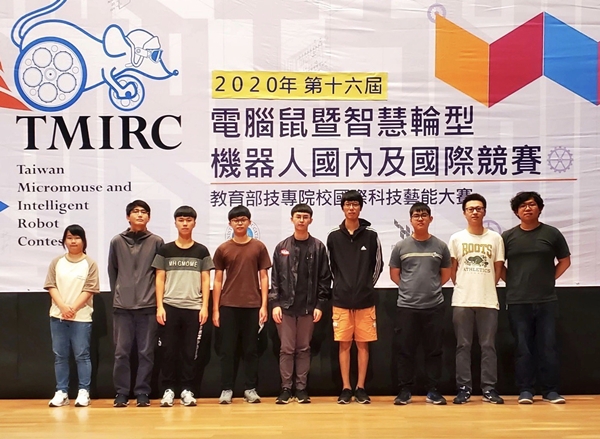
[The student team of the Department of Electronic Engineering of STUST won the championship and runner-up.]
In view of the fact that the making of a computer mouse maze competition is of great help in improving students' optical-mechanical integration design and production capabilities, the Technical and Vocational Department, the Ministry of Education, has been holding a national computer mouse maze competition since 2005 and sponsored the winners to participate in corresponding international competitions. The team from the STUST has repeatedly represented Taiwan in the world’s most advanced computer mouse competitions in Japan. In addition to being top-four winners over the past years, it has also won multiple awards, such as Discovery Awards, Special Awards, and Special Awards for Groups. The excellent ability of STUST in robot production has been demonstrated in world-class competitions, and international friends have been deeply impressed by Taiwan's solid technical and vocational education.
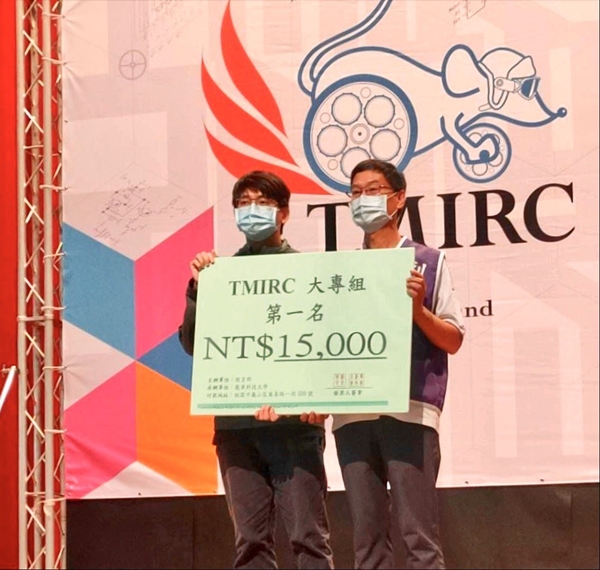
[STUST won the first place of the computer mouse maze competition in the university group.]
The computer mouse maze competition has been widely welcomed since the first world computer mouse maze competition was held in Tsukuba, Japan, in 1985. Up to the present, computer mouse maze competitions have been continuously held all over the world, such as the United States, Japan, Taiwan, and many other countries. They appeal to many students and experts and encourage them to join the ranking of computer mouse production and competition. With the rapid development of semiconductor technology and single-chip microcomputer integration technology, the capabilities of computer mouse robots are also changing with each passing day. Whether it is mechanism, digital control, or algorithm, there has been considerable progress. The competitions are becoming fiercer as a win could be determined within 0.1 second. In order to break through the speed limit of computer mouse, the computer mouse production team of STUST especially installed a self-designed and self-manufactured mini-fan on the computer mouse to exhaust the air between the computer mouse body and the ground, which greatly improved the grip of computer mouse and make them run faster, thereby winning the championship and the runner-up altogether.
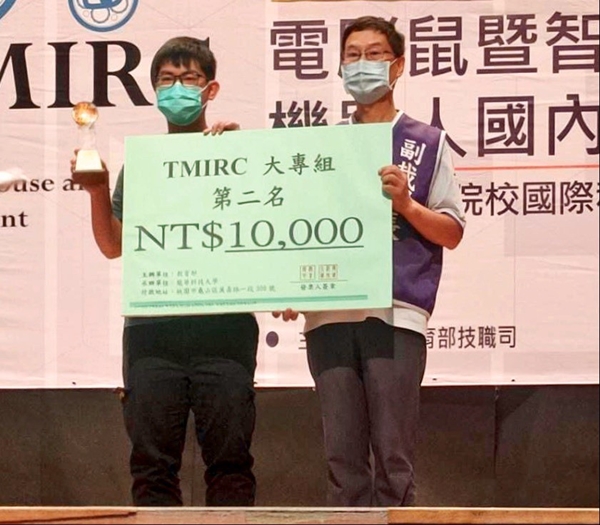
[STUST won the second place of the computer mouse maze in the university group.]
President Deng-Maw Lu of STUST said that thanks to the instructors and students for their hard work, STUST could achieve good results in the competition and would represent the country in international competitions. It is hoped that the team can win glory for the country in the future. STUST has always attached great importance to the production of student projects. In addition to allowing students to understand the structure and concepts in theory, it also pays more attention to enabling students to effectively apply these concepts to solving problems and to bring out the benefits of applying what they have learned. The computer mouse maze competition involves sensor application, artificial intelligence, automatic control, computer operation and machinery knowledge in many different engineering fields. It is of great help in cultivating students' innovation and practical ability as well as promoting education reform. The method not only inspires students' interest in practical topics, but also inspires their creativity.
|