|
STUST recently held the first general education master lecture of the 109 academic year. In order to change the serious and dull opening ceremony in the past, this lecture specially arranged an opening by the students from the Department of Popular Music Industry for the lecture. The songs were integrated with the topic, the lecturer, and other related elements, bringing a new feeling to the venue with vitality and enthusiasm.

[Students from the Department of Popular Music Industry performed for the opening of the "General Education Master Lecture."]
The STUST General Education Lectures specially invited Assistant Professor Yi-Wei Lai of the Department of Electrical Engineering, National Taiwan Normal University, to kick off the series of general education master lectures. Professor Yi-Wei Lai is a PhD from the Department of Electrical Engineering, National Taiwan University, a co-founder of the mathematics promotion platform "Numeracy Lab," and the special editor of the "Numeracy Series" published by Faces Publishing Ltd. He has engaged in research exchanges in Hong Kong, the United States, Germany, and Japan, and is committed to mathematics education and popular science education promotion. In 2016, he won the Mathematics Award of the Fifth China Pineapple Science Award.
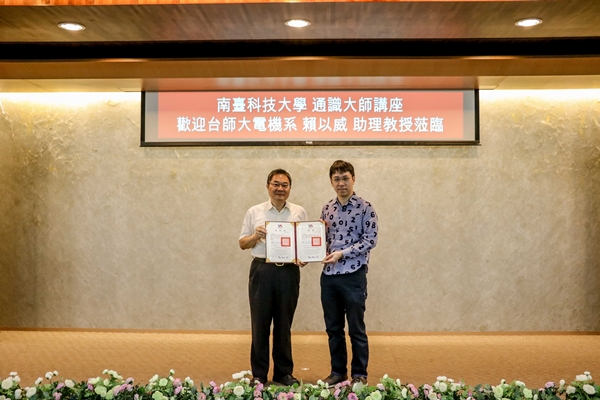
[STUST General Education Center Director Chuang-Shiong Chiu (left) especially presents a letter of appointment to Professor Yi-Wei Lai (right).]
In this lecture, Professor Lai used "Numeracy" as his topic, showing that in Taiwan, mathematics gives people a feeling of "complex calculations that are boring and have nothing to do with life and are boring." In order to open up the thinking of students about mathematics and apply it to life, the whole speech focused on "Helping you make good decisions in love", explaining that "37% in Math " is the key number for choosing the best partner in life. First of all, he gave a famous example: When Plato asked his teacher Socrates what love is, Socrates asked him to cross a wheat field to select the largest, particularly golden, wheat ears; Then, Plato did see a few great wheat ears plants in the field, but always thinking that there might be better ones ahead, they got very picky all the time and finally came back empty-handed. Only then did Socrates respond to him: "This is love." However, the example above is a humanistic interpretation. A mathematician would conclude that one should not choose the "first 37%" he or she encounters in life. It later he or she encounters anything that is better than the previous 37%, it is worthy settling down with that. Therefore, from the perspective of life, one starts from 18 years old to actively seek his or her partner; yet, by the age of 26, he or she should begin to get cautious, and he or she should be persistent with such an attitude before he or she turns 40. However, if the risk of being rejected is added, the point of time for finding a partner can be moved back to the "first 25%," and the percentage of find one’s true love in a lifetime can be increased to 61%. This "first 37%" choice is not only good for love, but also for interviews or the probability of choosing a parking space. It should be therefore concluded that the numeracy can be used in life.
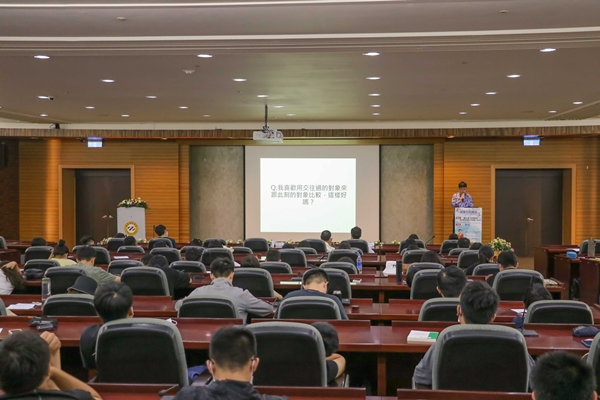
[The "General Education Master Lecture" held by STUST]
|